

When Winter Ruled the Land: Life of Slovenian Ancestors in a World of Deep Snow
In recent days, after a long time, parts of Slovenia have again been covered by up to 35 centimeters of snow. Alongside traffic chaos, slow journeys on snow-covered roads, and shoveling snow from in front of our homes, this kind of winter unexpectedly reminded me of the winters of my childhood. Back then, snow was a regular companion of the winter months—not a short-lived exception, but something entirely normal. The sense that life slowed down and withdrew into the safe shelter of the home was nothing unusual.
Looking further back into the past, it becomes clear that our ancestors in Slovenia lived with snow and low temperatures far more intensely and for much longer periods than we do today. Winters in the eighteenth and nineteenth centuries, and well into the twentieth century, did not last just days or weeks, but often several months. Deep snow, frozen roads, and severe cold were constants that shaped the rhythm of work, movement, and family life. Living with snow was not an occasional disruption, but the basic framework within which people learned how to survive, adapt, and create a sense of home even in the harshest winter conditions.
Snow as a Constant in the Slovenian Lands
Historical sources, chronicles, and later meteorological records clearly show that winters in the Slovenian lands were generally colder and far snowier in the past than they are today. This was especially true during the so-called Little Ice Age, which lasted roughly from the sixteenth to the mid-nineteenth century. In many places, snow did not merely fall—it remained on the ground continuously for months at a time. Frozen rivers, buried paths, and delayed springs were part of everyday experience.
The amount of snow depended greatly on geography. Alpine regions and higher mountain valleys were regularly covered by snow several meters deep, while the lowlands experienced somewhat less—but still enough to disrupt traffic, trade, and everyday contact between communities for extended periods. In such conditions, survival depended on self-sufficiency, careful preparation, and mutual assistance among neighbors.
Winter in the Countryside: Life Around the Stove
For the rural population, winter meant a retreat of daily life into the interior of the home. Fields lay dormant, but responsibilities did not disappear. Livestock still needed to be fed, food supplies carefully managed, roofs cleared of heavy snow, and constant warmth maintained indoors. The stove became the heart of the household.
My grandfather, Alojz Trnovšek (born 1912), spent long winter evenings by the stove repairing and making farm tools. Rakes, pitchforks, brooms, and wooden handles were carefully fixed and prepared for the coming season. Winter was a time of maintenance and preparation—a period of quiet, focused work that ensured the farm would function again in spring. This kind of winter labor was not exceptional, but part of the normal rural rhythm, repeated year after year.
The stove was also a place of stories. Children sat on or beside it, listening to older family members talk about past winters, hardships, weddings, accidents, and moments of joy. Winter evenings were a key time for passing on memories, experiences, and values from one generation to the next.

Winter of 1952: Collapse, Record Snow, and a Wedding in a Snowstorm
The winter of 1952 remains one of the most striking examples of how profoundly snow could shape everyday life in Slovenia. Between February 13 and 15, snow fell continuously for three days and three nights across the country. It accumulated on an existing snow base of around half a meter, worsening conditions dramatically. In Ljubljana, the snow cover reached a record 146 centimeters. In Postojna it approached one meter, while in the Alpine regions snow was measured in meters. In the Tolmin area and in Planica, more than two meters of snow fell, and snowdrifts in some places reached heights of up to eight meters.
Slovenia effectively came to a standstill. Bus and rail traffic were completely paralyzed, telephone lines were cut, and large areas were left without electricity. Even the famous Orient Express failed to reach Ljubljana. City streets became impassable, trams stopped running, and people moved through towns and villages via hand-dug snow corridors. In some houses, residents had to exit through windows because doors were completely buried by snow.
The situation was so severe that on February 18, 1952, the government of the People’s Republic of Slovenia declared a mobilization of the workforce to deal with the consequences of the snow disaster. Despite military assistance and mass civilian involvement, full railway service was restored only after two weeks. In remote areas that remained cut off, food and medicine were delivered by military aircraft. The human toll was significant as well: 31 people lost their lives, dozens were seriously injured, and material damage was extensive.
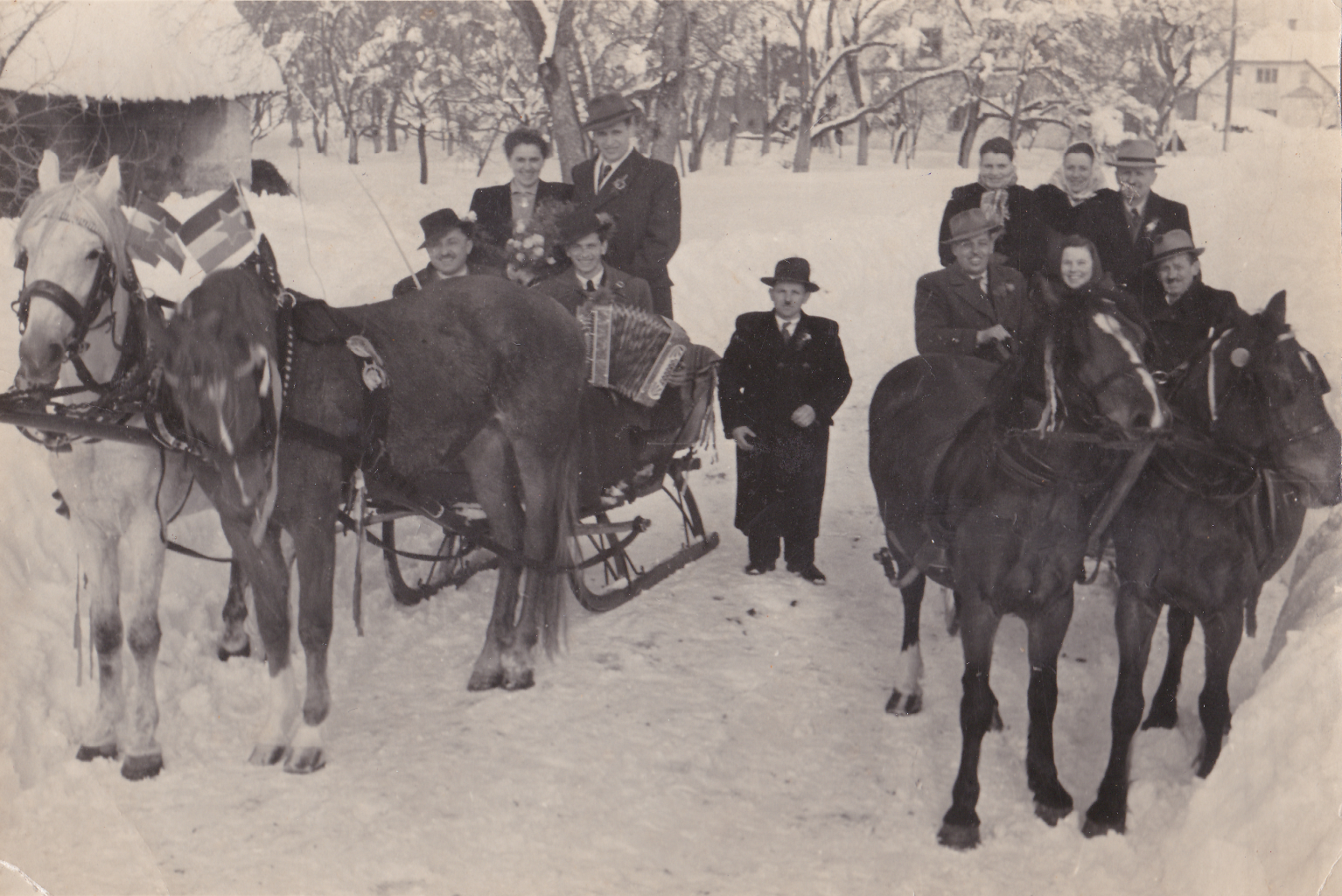
It was under these extraordinary conditions that, on February 17, 1952, my grandfather Alojz Potokar (born 1926) and my grandmother Urška Skubic (born 1919) were married in the town of Višnja Gora. Because of the snow and the halted railway traffic, the intended best man from a nearby village could not reach the wedding. Since the ceremony could not be postponed, my grandfather had to find a random wedding witness in a nearby inn so that the marriage could take place at all. Photographs from that day vividly show the scale of the winter: snow rises higher than some of the wedding guests standing in the images, offering a powerful glimpse into the reality of life during that winter.
Living With Winter, Not Against It
For Slovenian ancestors, winter was not a picturesque backdrop but a prolonged and demanding life condition. It shaped work, family relationships, community rhythms, and everyday survival. It was a time of limitations, but also a time of closeness—of stories told by the stove, of quiet work, and of children’s play in deep snow. When we look at a snow-covered landscape today, we are glimpsing a world that was once entirely normal—a world in which generations learned how to live with winter, not in spite of it, but alongside it.
