

At 14 at the Altar: Marriage Age in 18th-Century Slovenia
In the 18th century, the minimum age for marriage was not set by the state but by the canon law of the Catholic Church. Under these rules, a marriage was legally valid from the age of 12 for girls and 14 for boys. This was not a social ideal but an extreme legal threshold: the Church could not declare such marriages invalid if the spouses understood the basic meaning of marriage.
In practice, such early marriages were rare, but possible. They most often occurred under specific circumstances—inheritance issues, economic necessity, or family decisions. These were not only noble “strategic marriages”: many records from rural parishes show that very young couples also married in village settings, where marriage primarily meant the organization of household, labor, and survival, rather than a romantic choice.
Three cases of 14-year-old brides from the Parish of Polšnik
In the marriage registers of the Parish of Polšnik (1784–1812), I identified three cases of 14-year-old brides and one 14-year-old groom. In 1786, two 14-year-old girls married: Helena Rozina (14) married Marko Rozina (14), and Maria Medved (14) married Jožef Smuk (18). In 1799, Marija Sladič (14) married Anton Kastelic (19).
These data genuinely surprised me. I could not help but wonder how someone at such an age could be even remotely prepared to enter married life. When I think back to myself at fourteen, the confusion only deepens. Does this mean that children in the 18th century were biologically or sexually more mature than they are today? Scholarly research suggests the opposite. Studies show that puberty in pre-modern societies was often later, not earlier, largely due to poorer nutrition and frequent illness. This means that the legal marriage thresholds of twelve or fourteen years of age did not reflect actual physical maturity, but rather a legal minimum that made marriage possible only under exceptional circumstances.

At least in the case of the marriage between Marija Sladič (14) and Anton Kastelic (19) in 1786, it is known that they had their first child only two years after the wedding. According to well-established historical research, girls in the 18th century typically experienced their first menstruation around the age of sixteen. Whether the delayed pregnancy was due to the fact that Marija had not yet reached sexual maturity is something we will unfortunately never be able to determine.
City and Countryside: Two Different Ways of Life
Is there a real difference between the age at marriage in rural and urban settings, or is it merely our modern perception? To move beyond impressions and assumptions, I turned to the data. I first analyzed marriages in the parish of Polšnik (the villages of Polšnik and Mamolj) over the longer period 1784–1812, and then examined marriages in the distinctly urban parish of Ljubljana – St. James between 1790 and 1793. The aim was to determine whether a systematic pattern emerges when a larger number of marriages is considered.
A total of 172 marriages were included in the analysis: 80 from the rural parish of Polšnik (1784–1812) and 92 from the urban parish of Ljubljana – St. James (1790–1793). The results were clear. Even when all marriages are taken into account—including those contracted later in life and obvious remarriages—the difference between town and countryside does not disappear. In the rural setting, grooms were on average around 29 years old at marriage, while brides were approximately 24 years old. In the urban parish, however, grooms were already on average about 36 years old, and brides around 29 years old.

Even when marriages in which at least one spouse was older than 45 years—thus very likely a widower or widow entering a second marriage—are excluded, the average age at marriage in both settings decreases by roughly two years. The difference between town and countryside, however, remains just as pronounced: marriages in the urban environment still took place several years later than in the rural one, confirming that this is not merely the result of remarriages but reflects fundamentally different ways of life in the two settings.
A difference of only a few years between rural and urban marriage patterns may not seem significant at first glance, yet in a historical context it is highly meaningful. It indicates that people married at different stages of life because they lived according to different life logics. In the countryside, marriage closely followed the rhythm of land, household, and work: when it became necessary to secure labor or ensure the continuation of a household, marriage tended to take place earlier. In the urban environment, by contrast, marriage was usually tied to one’s occupational path. An artisan, merchant, or servant often first had to complete training, finish an apprenticeship, or attain master status before marriage became a realistic option and a foundation for starting a family.
When Did People Marry in the 18th Century—and When Do We Marry Today?
Data from the 18th century reveal a very pronounced seasonal pattern, especially in rural areas. In the parish of Polšnik, most marriages took place in winter, particularly in January (17) and February (29), while March was almost entirely avoided (1), clearly coinciding with the Lenten period. In spring and summer, marriages were far less frequent—3 in April, 10 in May, 3 in June, 4 in July, and 7 in August—with even fewer weddings in autumn (2 in October and 4 in November). This distribution clearly reflects rural realities, where marriage was scheduled after the Christmas holidays and before the onset of intensive agricultural work and liturgical restrictions.
In the urban parish of Ljubljana – St. James, the picture is quite different. Although January (13) and especially February (20) still stand out, marriages were not confined to winter alone. A substantial number also took place in May (14) and November (11), as well as during the summer months—June and July (8 each) and August (7). Two quieter periods nevertheless stand out: March and April, when marriages were rare due to Lent, and December, when none occurred at all. This shows that the Church calendar strongly influenced marriage timing in both town and countryside.
If we compare these figures with present-day marriages in Slovenia, the differences are striking. In the 18th century, weddings followed the Church calendar and work cycles, whereas today they are shaped primarily by weather, leisure time, and weekends. January—once the peak wedding month in rural areas—is now the month with the fewest marriages, while summer and early autumn have become the new “wedding season.” It is precisely in this shift of the annual rhythm that we can most clearly see how profoundly everyday life has changed between us and our distant ancestors.
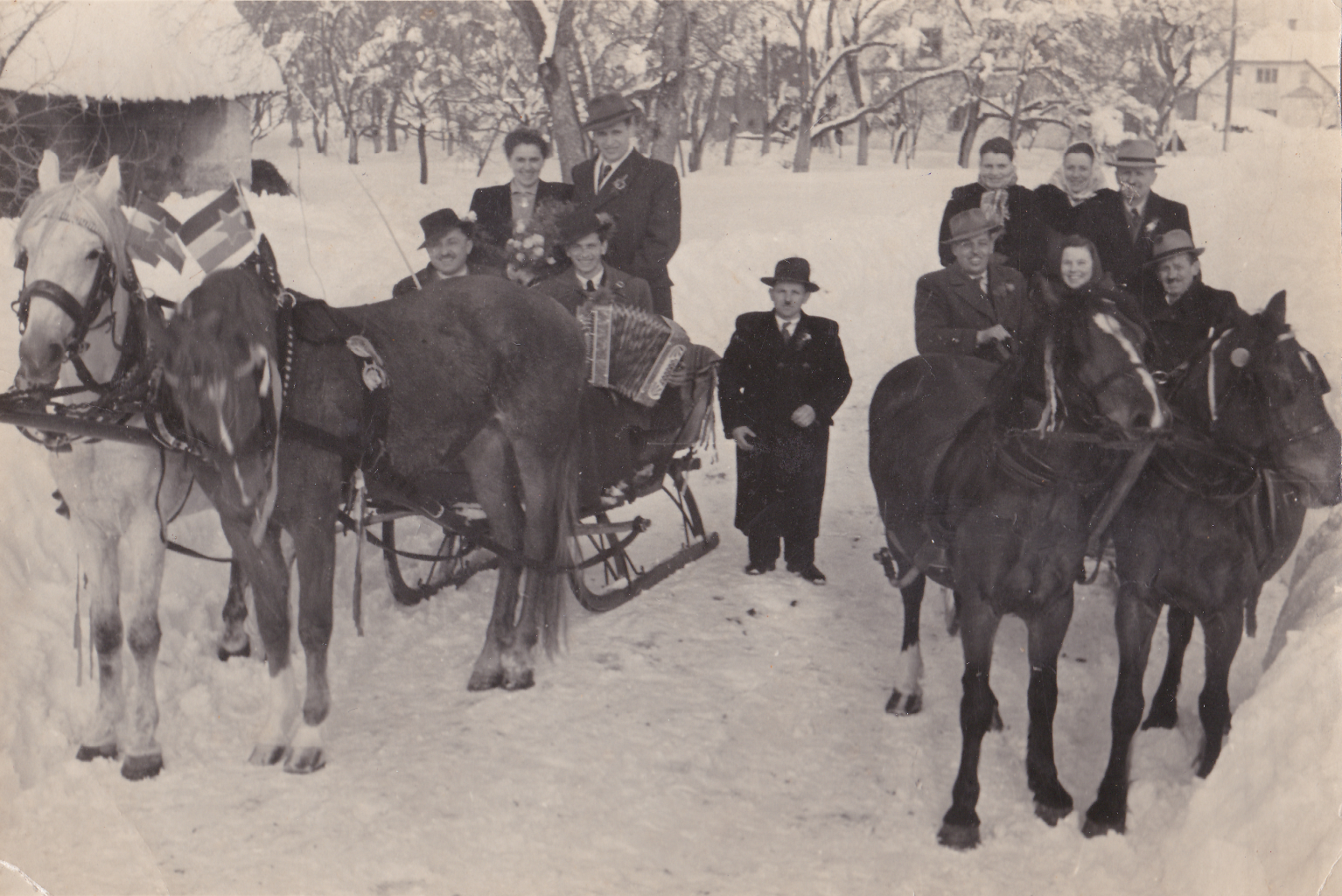
It is perhaps through marriage statistics that we can most clearly see how far our everyday lives have moved away from those of our ancestors—and how different the reasons are today for stepping before the altar. But that is a story for another time. 🙂